Built to Belong: How Denmark's Co-Housing Revolution Is Exposing the Architecture of American Loneliness
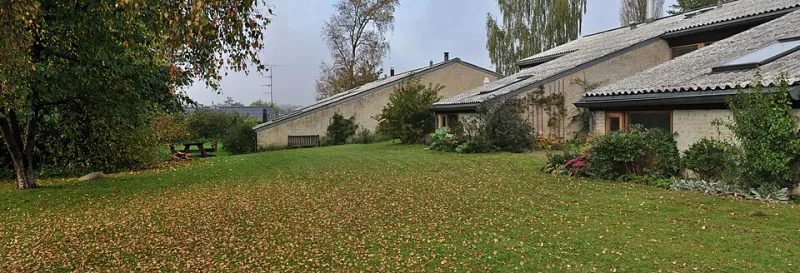
Photo: seier+seier, CC BY 2.0, via Wikimedia Commons
The U.S. Surgeon General called loneliness an epidemic in 2023. Think tanks published reports. Podcasts were recorded. People nodded along and then went home to houses designed specifically to prevent any accidental interaction with their neighbors.
There's a reason the loneliness conversation keeps spinning in place without producing much change. We keep treating it like a personal problem — a failure of individual social effort, something to be solved with apps, therapy, or the courage to finally join that book club. What we rarely talk about is that the physical environments most Americans live in are structurally hostile to the kind of casual, low-stakes human contact that actually builds community over time.
Denmark has been quietly building the alternative for decades. It's called bofællesskab — co-housing — and it's less a utopian experiment than a straightforward architectural argument: if you design space for connection, people connect.
What Co-Housing Actually Is (And Isn't)
Let's clear something up immediately, because the American imagination tends to run toward communes the moment shared living gets mentioned. Danish co-housing is not that. Residents have fully private homes — separate entrances, their own kitchens, their own space to close the door and disappear. Privacy is non-negotiable and architecturally guaranteed.
What's different is what surrounds those private homes. A shared common house, typically at the center of the development, with a large kitchen and dining room where communal meals happen several times a week. Shared workshops, gardens, laundry facilities, guest rooms. Outdoor courtyards designed so that moving through the community means passing through shared space rather than retreating directly from front door to garage.
That last part is more important than it sounds. The American suburb was largely designed around the private automobile, which means the dominant spatial experience is: exit house, enter car, exit car, enter destination. You can live next to someone for fifteen years and never once have an unplanned conversation with them. The design makes it easy to avoid each other — and we do.
Co-housing flips that logic. The layout creates what urban designers sometimes call friction — not in a negative sense, but in the sense of small, organic encounters that accumulate into actual relationships. You cross paths with your neighbor at the shared tool shed. You end up at the same communal dinner on a Wednesday night not because you planned it but because you live somewhere that made it easy.
The Numbers Behind the Feeling
Denmark has over 700 co-housing communities. They range from urban apartment clusters in Copenhagen to rural developments that look like small villages. The model has been refined over roughly fifty years, and at this point it's neither fringe nor experimental — it's a recognized and respected housing category with its own legal framework, financing structures, and architectural vocabulary.
Residents consistently report higher levels of social connection and lower levels of isolation than people in conventional housing. Elderly residents age in place longer. Single parents get genuine support networks. Young people build friendships that don't require coordinating calendars three weeks in advance.
None of this is magic. It's spatial design doing what spatial design does when it's pointed at human wellbeing rather than car storage.
The American Suburb Was a Choice, Not a Default
It's worth sitting with the fact that the American housing model — single-family home, attached garage, fenced yard, minimal shared infrastructure — was not an inevitable outcome of how humans prefer to live. It was a policy choice, heavily subsidized, built on specific assumptions about privacy, property, race, and the relationship between domestic space and social status.
Those assumptions produced the physical environment that is now producing the loneliness epidemic. The cul-de-sac didn't cause isolation by accident. It was designed, at least in part, to create separation. The question is whether we're willing to build differently.
Some American communities are trying. The Quayside Village in Vancouver (close enough to count as a North American reference point) has operated on co-housing principles for years. Intentional communities in places like Ithaca, New York and Portland, Oregon have adapted the Danish model with varying degrees of success. There's genuine momentum, particularly among people in their 30s and 40s who've done the math on suburban homeownership and found it both financially and socially unsatisfying.
But the structural barriers are significant. American zoning laws were written to prevent exactly the kind of density and mixed-use design that co-housing requires. Financing is complicated because the model doesn't fit neatly into conventional mortgage categories. And culturally, there's still a reflex — particularly strong in certain regions — that equates shared space with compromised independence.
What the Common Kitchen Actually Does
Here's the detail that keeps coming up in research on co-housing communities: the shared kitchen is the heart of everything. Not symbolically — literally. The communal meals that happen in that space are where casual acquaintance becomes genuine friendship, where people in different life stages interact naturally, where kids grow up knowing their neighbors' names.
American housing design has systematically eliminated the spaces where that kind of interaction can happen. We privatized the front porch when we attached the garage. We eliminated the stoop when we set houses back from the sidewalk. We built neighborhoods where the only shared infrastructure is the road, which is not exactly a space for lingering.
The Danish co-housing model is, among other things, a bet that people actually want to know each other — that the isolation of conventional suburban life is a design failure rather than a revealed preference. The evidence from communities that have been running for twenty or thirty years suggests that bet is paying off.
Building the Conditions for Connection
What's quietly radical about the co-housing argument is that it refuses to treat loneliness as a personal problem requiring a personal solution. It says: look at the building. Look at where the doors open and what they open onto. Look at whether the physical environment makes it easy or hard to be in casual contact with the people around you.
That's a different conversation than the one most American wellness culture is having. And it's one that probably makes developers, zoning boards, and a certain strain of individualist political culture deeply uncomfortable.
Which is, honestly, a sign you're onto something worth talking about.