From Forest to Framework: How Scandinavian Wood Wisdom Is Quietly Rewriting American Architecture
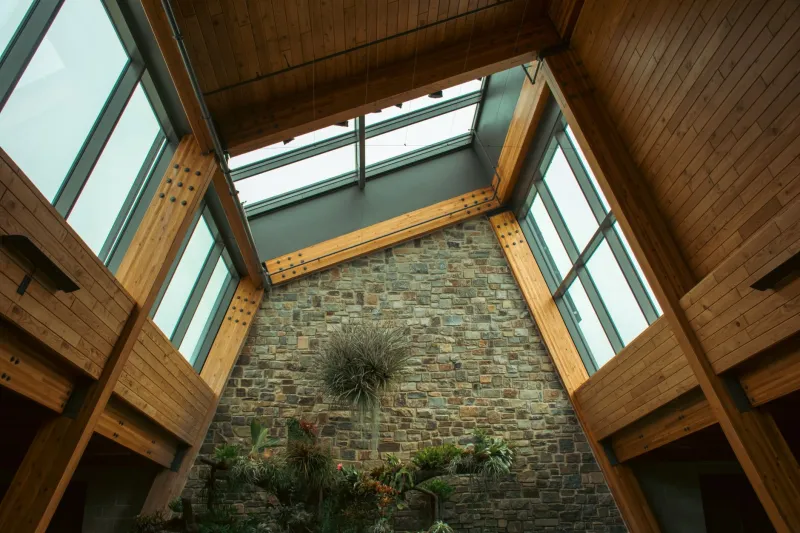
There's a building going up in Portland, Oregon that smells like a forest. Walk through its lobby and you'll catch the faint, resinous scent of Douglas fir. Run your hand along the wall panels and you'll feel something that concrete and drywall have never once offered: warmth. The architect behind it spent six months in Norway. That's not a coincidence.
Across the US, a quiet but genuinely radical shift is happening in how we build things — and the blueprint is coming from Scandinavia. Nordic countries have spent centuries developing an almost philosophical relationship with timber. Not just as a building material, but as a cultural inheritance, a sustainability commitment, and frankly, an art form. American architects are now borrowing from that tradition with a kind of reverence that the industry hasn't seen in decades.
Wood as a Worldview
To understand why this matters, you have to understand how differently Nordic cultures relate to forests. In Finland, there's a concept called metsänhenki — the spirit of the forest — that reflects a deep, almost spiritual connection to woodland environments. Sweden manages roughly 28 million hectares of forest under some of the world's most rigorous sustainability frameworks. Norway's timber construction traditions stretch back to the Viking Age stave churches, some of which are still standing after a thousand years.
This isn't nostalgia. It's a living design philosophy. When Norwegian firm Snøhetta or Swedish studio Wingårdhs incorporate timber into contemporary projects, they're drawing on an unbroken chain of material knowledge that American construction culture — which largely abandoned wood for steel and concrete in the 20th century — simply doesn't have. Yet.
The CLT Revolution (And Why It Took America So Long)
Cross-laminated timber, or CLT, is the material that's been making headlines in architectural circles for the past decade. Think of it as plywood's ambitious, load-bearing cousin — layers of solid wood stacked and glued at perpendicular angles to create panels that can replace concrete slabs and steel beams in mid-rise and even high-rise construction. Austria and Sweden were mass-producing it by the early 2000s. The US didn't update its building codes to properly accommodate CLT until 2015.
That gap tells you something. Nordic countries were decades ahead not because they had better technology, but because they never lost faith in wood as a serious structural material. Firms like Stockholm-based White Arkitekter have been designing large-scale timber buildings — schools, offices, apartment blocks — for years. Their work proved what American skeptics kept questioning: that wood could be fire-resistant, structurally sound, and cost-competitive at scale.
Now US firms are playing catch-up fast. Michael Green Architecture, based in Vancouver but hugely influential in the American market, has been evangelizing mass timber for years. Their published research and completed projects helped shift the conversation. Meanwhile, cities like Portland, Seattle, and Denver have become testing grounds for CLT construction, with developers increasingly drawn to both the environmental story and the aesthetic warmth that timber brings to commercial and residential spaces.
Joinery as Craft, Not Just Construction
Beyond the structural innovation, there's something subtler happening — a renewed American interest in traditional Nordic joinery techniques that prioritize craftsmanship over speed. Scandinavian woodworking has always valued the joint: the dovetail, the mortise-and-tenon, the intricate interlocking forms that hold structure together without relying on metal fasteners. These methods are slower and more expensive, but they produce connections that are visually beautiful and often stronger over time.
Interior designers in cities like Brooklyn, Austin, and San Francisco are increasingly specifying custom millwork that draws on these traditions. Furniture makers trained in Nordic techniques — some through exchange programs with schools like Denmark's Designskolen Kolding — are finding a hungry American market that's exhausted by flat-pack culture and craving objects that feel considered and durable.
The appeal isn't purely aesthetic. There's a growing awareness that the throwaway design economy has real environmental costs, and Nordic craft traditions offer a compelling counter-narrative: build it right, build it to last, and let the material age beautifully rather than degrade cheaply.
Sustainability Isn't a Selling Point — It's the Foundation
One of the most striking differences between Nordic and American approaches to timber construction is where sustainability sits in the conversation. In the US, it's often framed as a feature — a green certification to add marketing value, a talking point for environmentally conscious buyers. In Scandinavia, sustainable forestry isn't a selling point. It's the baseline assumption.
Sweden's forestry model, for instance, mandates replanting for every tree harvested and maintains strict biodiversity protections that go well beyond what US regulations require. Finnish architects routinely work with certified timber suppliers as a default, not a premium option. The result is a supply chain that designers can trust and a material culture that feels genuinely integrated rather than performatively green.
American architects who've spent time studying in or collaborating with Nordic firms often come back talking about this cultural gap more than any specific technique. The material knowledge matters, but the underlying attitude — that building responsibly isn't an extra effort, it's just how you build — is the real lesson worth importing.
What American Cities Are Actually Building
The proof is showing up in skylines and neighborhoods. The Framework project in Portland — a 12-story mass timber tower — became a landmark case study for what CLT could do in the American context before financial complications stalled it. But it opened doors. The Brock Commons Tallwood House at the University of British Columbia, while Canadian, became a reference point for US developers pushing for taller timber structures.
In Chicago, architects are exploring timber hybrid systems that combine CLT floors with steel cores. In Atlanta, residential developers are using exposed timber framing as a design feature in multifamily housing, tapping into both the sustainability narrative and the warmth that timber brings to urban living. Even corporate campuses — notoriously conservative in their material choices — are starting to incorporate mass timber in cafeterias, collaboration spaces, and building facades.
The trend lines are clear. The US mass timber market was valued at around $1.2 billion in 2022 and is projected to grow significantly through the end of the decade. Nordic firms and consultants are increasingly involved in American projects, either as direct collaborators or as the intellectual inspiration behind design decisions.
The Bigger Picture
What's happening isn't just architects discovering a cool material. It's a deeper cultural reckoning with how the US builds — and what we've lost by treating construction as a purely industrial exercise. Nordic timber culture offers something genuinely different: a model where the forest, the craftsperson, the architect, and the building's occupants are all part of the same continuous story.
That's a design philosophy worth paying attention to. And if the buildings that come out of it happen to smell like a forest and feel like somewhere worth being, well — that's not a bad place to start.