Forage, Ferment, Forget Everything You Knew: How New Nordic Cooking Is Rewiring the American Kitchen
There's a jar of fermented gooseberries sitting on a shelf in a Nashville restaurant kitchen, and it has absolutely no business being there — at least not according to the culinary establishment that trained the chef who made it. That chef spent three years learning classical French technique, memorizing mother sauces, and perfecting the kind of precise, hierarchical cooking that has dominated fine dining for over a century. Then she ate at a restaurant in Copenhagen, and something broke open.
"It wasn't the food that got me," she says, wiping her hands on her apron. "It was the thinking behind the food. The whole relationship to the land, to waste, to time. I came back and I couldn't look at my menu the same way."
This is happening a lot right now. Across the United States, a growing number of chefs — some celebrated, many just quietly grinding — are abandoning the prestige-hungry logic of European fine dining and turning instead toward the Nordic north for inspiration. Not just recipes. Not just aesthetics. The whole philosophy.
What New Nordic Actually Means (And What It Doesn't)
Let's clear something up first: New Nordic Cuisine is not about meatballs and flatbread. It's not a cuisine in the traditional sense at all. Born out of a 2004 manifesto co-authored by Danish chef René Redzepi and food entrepreneur Claus Meyer, the movement laid out a set of principles rather than a menu. Purity. Simplicity. Freshness. Ethics. Seasonality. An almost devotional respect for local ingredients and the ecosystems that produce them.
When Redzepi's restaurant Noma opened in Copenhagen and eventually climbed to the top of every global best-restaurant list imaginable, the food world paid attention. But what's interesting — and arguably more culturally significant — is that the ideas didn't stay in Scandinavia. They migrated. And in the United States, they've landed in particularly fertile soil.
American chefs drawn to the Nordic model aren't just copying dishes. They're asking the same foundational questions: What grows here, right now? What did people in this region eat before globalization flattened everything? How do we honor an ingredient rather than perform with it?
The Philosophy Hits Different in America Right Now
There's a reason this movement is resonating so strongly in the US at this particular moment. American food culture has spent decades chasing novelty — the next fusion trend, the next Instagram-worthy plating style, the next imported technique. It's exhausting, and a lot of people know it.
New Nordic offers something that feels almost radical by contrast: slowness. Intention. A cooking philosophy rooted in place and season rather than trend cycles. For a generation of American eaters who've grown up watching food systems collapse under the weight of industrial agriculture, climate anxiety, and supply chain chaos, the Nordic emphasis on sustainability and locality isn't just aesthetically appealing — it feels genuinely necessary.
Chef Marcus Holt, who runs a tasting-menu restaurant in Asheville, North Carolina, describes it as a kind of ethical clarity. "French cooking gave me technique," he says. "Nordic thinking gave me purpose. I started asking what my sourcing actually means, what I'm contributing to or taking from. That's a different kind of cooking entirely."
Holt now works exclusively with farms within a 150-mile radius, preserves and ferments through the summer and fall to carry flavor into winter, and structures his menus around what's genuinely abundant rather than what's conventionally desirable. His dining room is full most nights.
Fermentation as Philosophy
If there's one technique that's become the most visible symbol of Nordic culinary influence in American kitchens, it's fermentation. Not just kombucha and sourdough (though yes, those too). We're talking about the kind of deep, patient, transformative fermentation that characterizes Nordic preservation traditions — lacto-fermented vegetables, aged dairy, cured fish, vinegars made from fruit scraps.
For Nordic cooks, fermentation has always been practical: you preserve what you have when you have it, because winter is long and unforgiving. But it's also become something more philosophical — a way of working with time rather than against it, of finding complexity through patience rather than technique.
American chefs are picking this up and running with it in ways that feel distinctly local. In the Pacific Northwest, where foraging culture was already strong, chefs are fermenting Douglas fir tips and wild mushrooms. In the South, there's a natural conversation happening between Nordic preservation principles and Appalachian pickling traditions. In the Midwest, chefs are rediscovering indigenous fermentation practices through a Nordic-influenced lens that centers terroir and restraint.
"Fermentation democratizes the pantry," says Brooklyn-based food writer and cooking instructor Dara Osei. "It's not about expensive ingredients. It's about attention and time. That's a very Nordic idea, and it's also a very radical one in a food culture that's been trained to want everything fast and easy."
Minimalism at the Plate
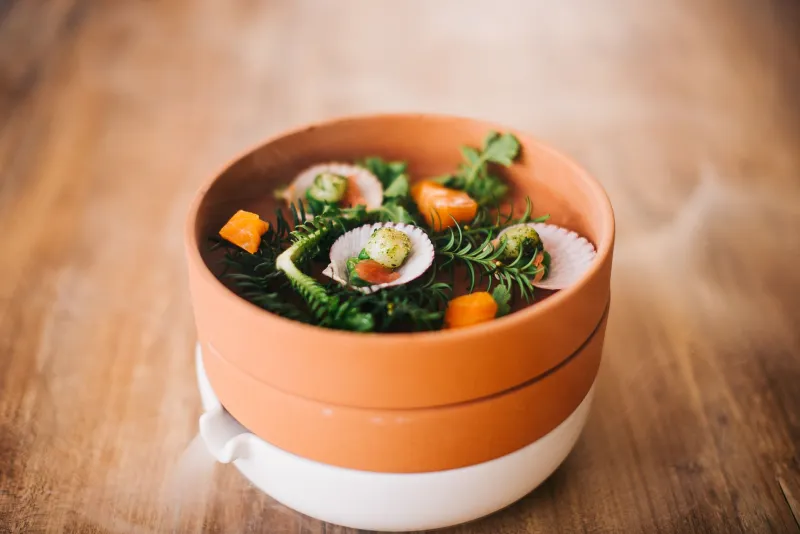
The visual language of Nordic cooking is also having its moment in American kitchens, and it's worth separating this from mere aesthetics. The minimalism you see in New Nordic plating — three or four components, negative space, textures that look almost accidental — isn't stylistic restraint for its own sake. It's an expression of the underlying philosophy: let the ingredient be the thing. Don't bury it in sauce or technique or ego.
For American chefs trained in more maximalist traditions, this requires genuine unlearning. "I used to think a dish wasn't finished unless it had at least eight components," admits one Los Angeles chef who asked to remain anonymous because, in his words, "my old mentor would be devastated." "Now I ask myself: what's the one true thing on this plate? And how do I get out of its way?"
This approach is showing up not just in fine dining but in the broader home cooking conversation too. Cookbooks drawing on Nordic principles — emphasizing technique over recipes, seasonal thinking over ingredient lists — are finding audiences well beyond the food-nerd demographic. People are tired of complexity for complexity's sake.
What Gets Lost in Translation (And What Doesn't)
It would be dishonest to pretend the migration of Nordic culinary ideas to America is frictionless. There are real questions about cultural borrowing, about whether chefs in, say, Phoenix or Atlanta can authentically engage with a philosophy so deeply rooted in a specific northern landscape and its indigenous knowledge systems. The Nordic model was built around specific ecologies — boreal forests, cold coastlines, particular fungi and berries and grains. You can't just transplant that.
But the most thoughtful American practitioners aren't trying to transplant it. They're using Nordic principles as a framework — a way of asking better questions about their own landscapes and food traditions. The goal isn't to cook like you're in Denmark. It's to cook like you actually care where you are.
And that, maybe, is the most Nordic idea of all: that cooking is an act of attention. Of presence. Of genuine relationship with the land and the people around you.
The jar of fermented gooseberries in Nashville isn't trying to be Copenhagen. It's trying to be Nashville, but with a little more patience and a lot more intention.
That's a revolution worth paying attention to.